
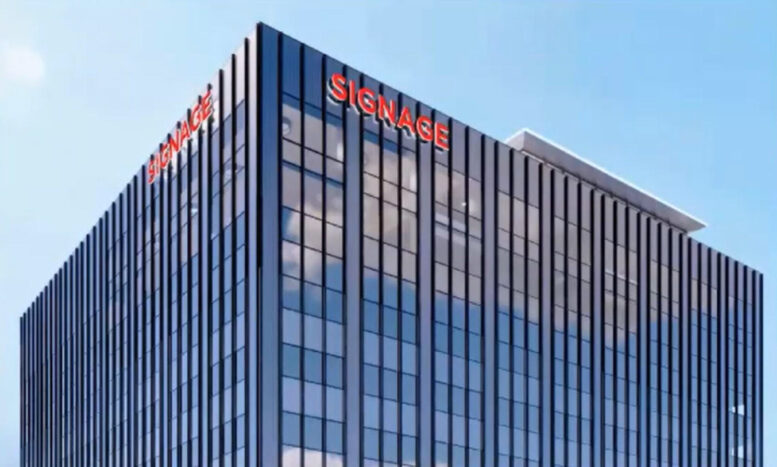
Partial funding has been approved for the residential conversion and partial redevelopment of the high-rise at 30 North LaSalle Street in The Loop. Sitting on the corner of West Washington Street, the project has been in the works for a few years under the city’s LaSalle Street Reimagined initiative, with updated renderings and information revealed last spring.
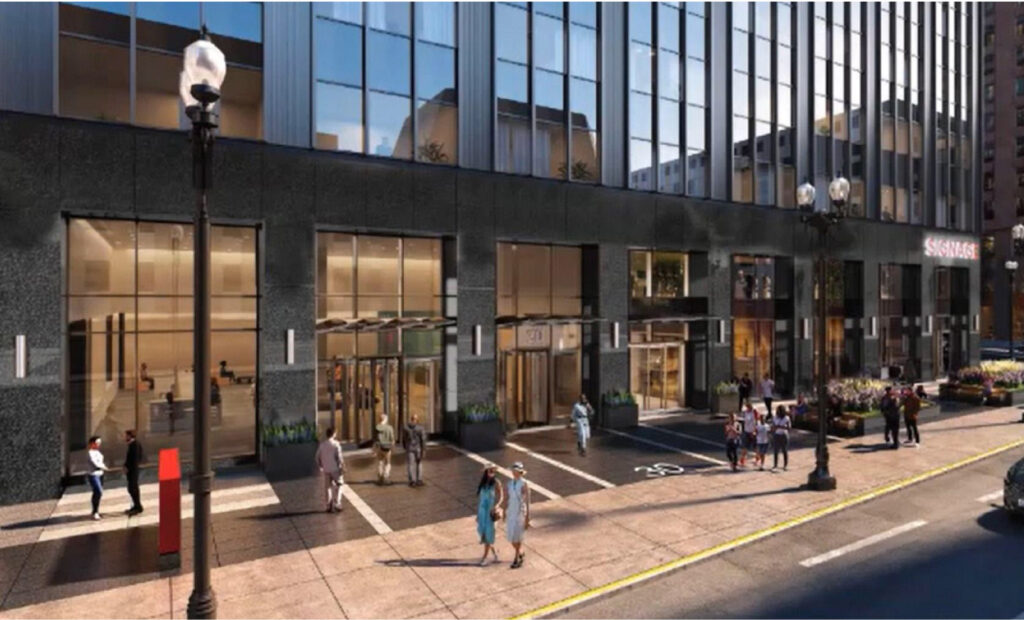
Rendering for 30 N LaSalle Street by SCB
The 44-story tower was built in 1974 in the International Style and has slowly been vacated as tenants continue to seek newer Class A office space nearby. As a result, local developer Golub & Company has been working with architecture firm SCB to partially pivot the structure to residential use.
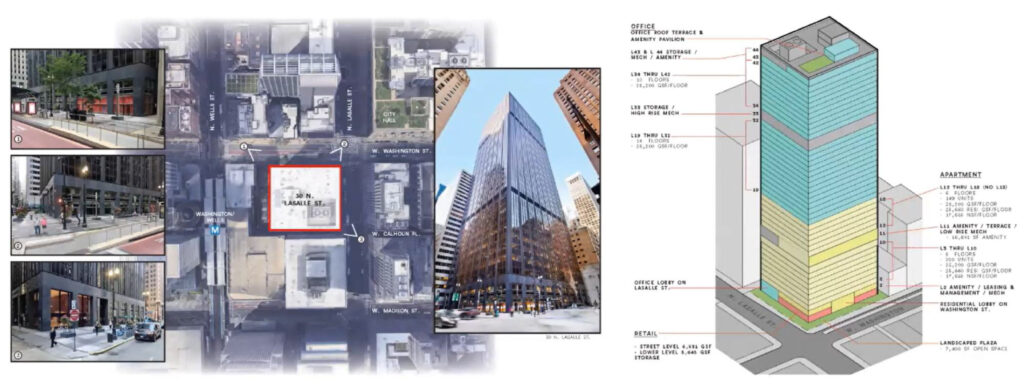
Program diagram for 30 N LaSalle Street by SCB
Work will begin with a reconfiguration of the ground floor to add a residential entrance, relocate the office entrance, and enhance the existing retail space. These updates will also extend outside to include a full reglazing of the tower, new signage on the first and top floors, as well as new landscaping and hardscaping for the surrounding plaza.
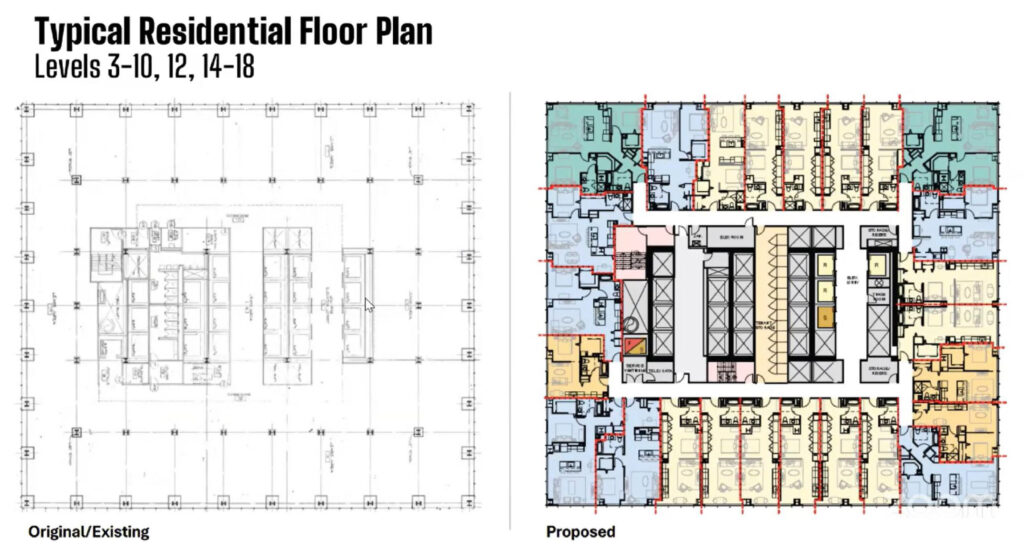
Floor plan for 30 N LaSalle Street by SCB
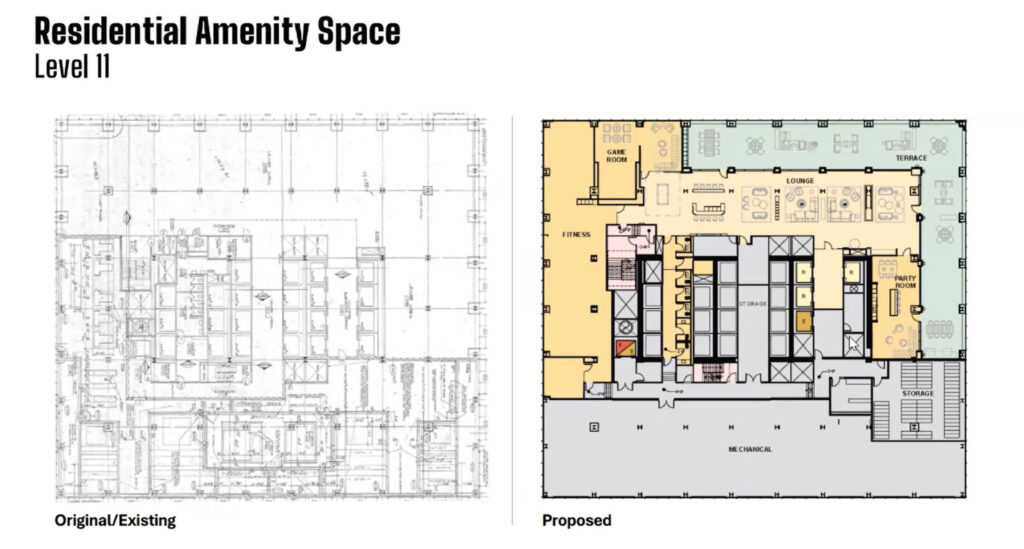
Floor plan for 30 N LaSalle Street by SCB
Inside, floors two through 18 will be converted to residential use, yielding 349 units consisting of 222 studios, 98 one-bedroom, and 29 two-bedroom layouts. To qualify for the initiative and city funding, 105 units—or 30 percent of the total—will be designated as affordable. Residents will have access to multiple amenity spaces, including a terrace on the 11th floor.
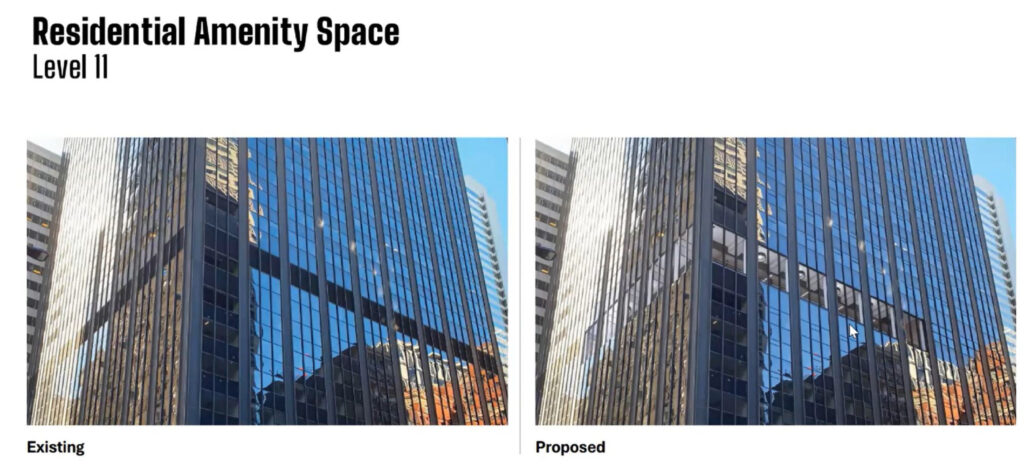
Rendering for 30 N LaSalle Street by SCB
The upper levels will remain office space, with floors 43 and 44 converted into new amenity areas for office tenants. Additionally, a small solarium and outdoor deck will be added to the rooftop. These improvements are intended to help attract new tenants, though future phases of conversion remain possible.
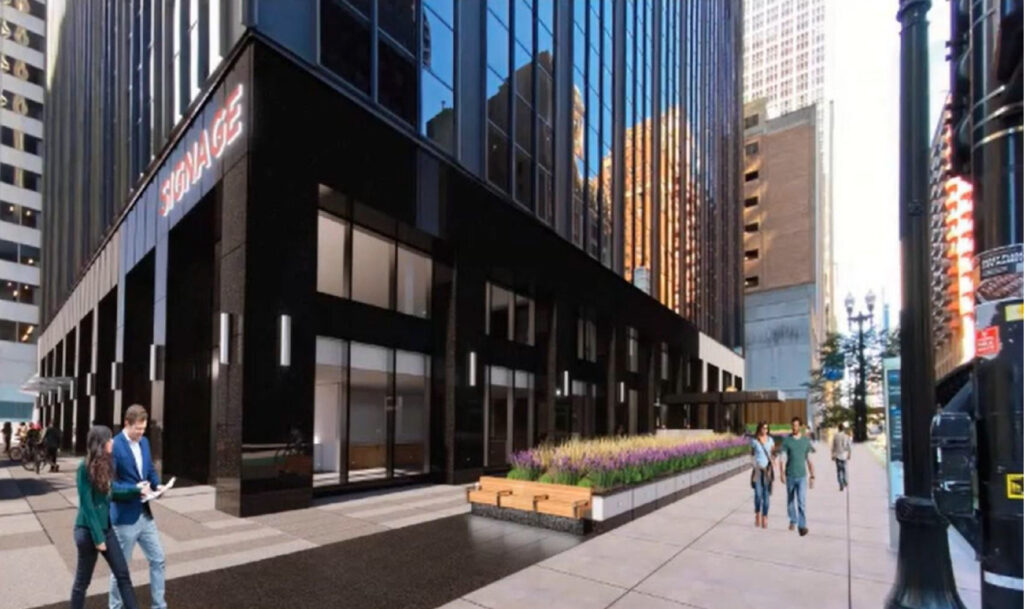
Rendering for 30 N LaSalle Street by SCB
The project is expected to cost approximately $135 million, with $57 million coming from TIF funds. Those funds have now been officially approved by City Council, clearing the way for the project to move forward. The development team must still secure final approval for Class L tax credits and close on $51 million in loans. A construction timeline has not yet been established.
Subscribe to YIMBY’s daily e-mail
Follow YIMBYgram for real-time photo updates
Like YIMBY on Facebook
Follow YIMBY’s Twitter for the latest in YIMBYnews
Great that this is one more step towards making the Loop a 24/7 neighborhood. I’m hopeful that over the next few years, the residential coming online in this area will draw more neighborhood oriented retail like supermarkets, hardware stores, cafes, bars, etc.
nice project
Is there a parking garage in this building? My concern is that people will move into these building conversions, park their cars in a garage nearby, and those garages will never be replaced with apartment buildings.
No there isn’t any parking garages in this building. And yes some of the residents will park nearby.
But that being said the demand for parking should be offset as the Loop becomes less dominated by office workers. In addition, the area has ample parking in the nights and weekends (non business hours) so I don’t think it should impact it that much.
While I prefer new projects having limited (or no) parking, I think that the impact of added parking is largely overstated on this website. I live in a condo in West Loop Gate (so not the Loop but as close as it gets) that has approximately 300 parking spots and where the average resident is 45-50 years old and physically capable. I would say that 30% of the parking spots never have a car parked in them, because their owners just use public transit, walk, or bike, and cars rarely move out of another 20% of the spots. I bet this is not an uncommon phenomenon in the Loop and adjacent neighborhoods. If you see a new building going up and it has 100 spots, I’d view the impact as another 60 cars added to the road in the area.
We’ve not been overstating it at all. The impact of a large garage isn’t just the number of cars it invites onto city streets on a regular basis. It’s how many units of housing and lost tax revenue that parking spaces consume whether there’s a car sitting in them or not. And also the effect when above ground is a dead antisocial inhuman experience for people outside of cars. There’s never anything attractive or inviting about a parking garage structure, ever.
This is not a model for residential conversion in the Loop. The public subsidies to this project – TIF gifts and landmark tax credits – run $108,000,000. Look at that on a per unit basis: $309,000 per unit, for a building that’s overwhelmingly tiny studios. TIF money and landmark tax credits are covering 80% of the cost of the project, and the fortunate owners will collect all the rents. The city won’t even benefit from tax revenue, since the l landmark credits will probably reduce the building’s tax bill below what it used to be. Insane is too kind a word for the government role in this project. Maybe if the city were awash in tax revenue this could be overlooked. But our city is functionally bankrupt, borrowing money at ever increasing rates to fund operating expenses.
Pure insanity.
I’m not so sure it’s crazy, you could say it’s the cost of doing insane mono-culture zoning for decades that resulted in office only non-neighborhoods. It’s expensive to undo this myopic mistake. But it’ll be more expensive to not do it.
We critically need to revive the Loop. It will cost money to do that. “We should do good things but just expect the invisible hand of the free market to do everything for us” has clearly been such a helpful line of thinking in the past for the neighborhood. The Loop is absolutely withering away and it desperately needs these projects. I expect massive returns on our investment here in the form of private investment elsewhere in the Loop.
It’s an appalling abuse of historic landmarking for a building that is not architecturally or historically noteworthy, except as the former site of the Chicago Stock Exchange.
I guess it could be worse; at least some housing will be created.
Completely agree with guenth. Is there another way to finance these without the tax credits that could make economic sense?