
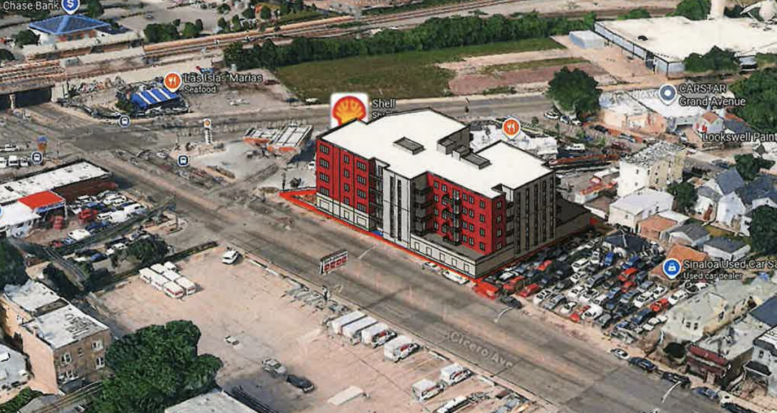
Plans have been revealed for a new residential development at 1759 North Cicero Avenue on the northwest edge of Austin. Located just south of the intersection with West Grand Avenue, the project would replace a former car scrapyard in a relatively industrial area just steps away from the Grand/Cicero Metra Station.
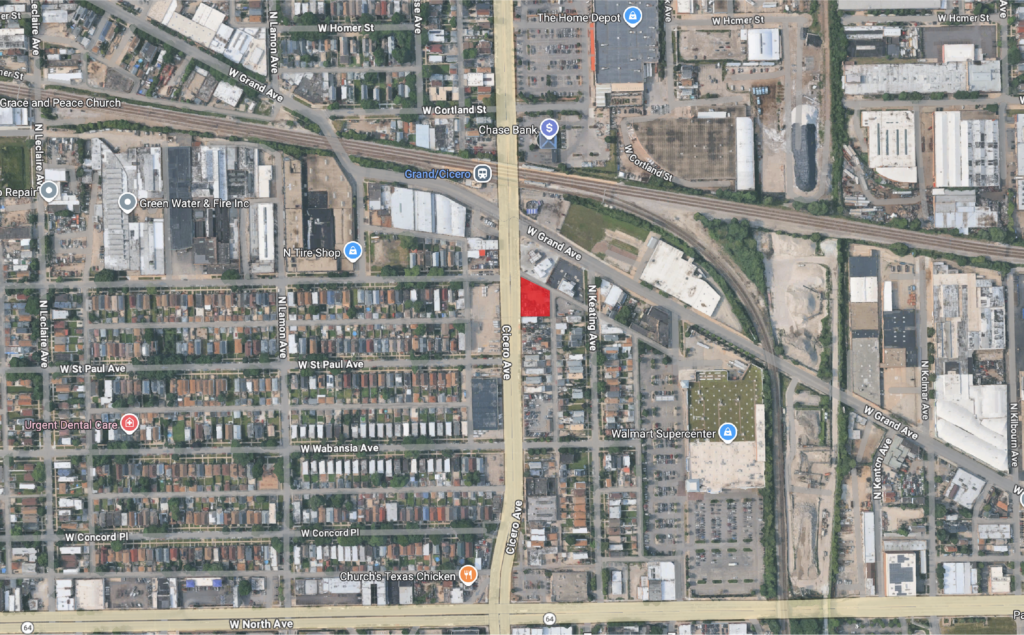
Site context map of 1759 N Cicero Ave via Google Maps
Efforts for the project are being led by a local developer under the name 1749 NCA LLC, who is working with local firm Barry Architecture on its design. The new five-story structure will be anchored by a small one-story podium which will span across the majority of the 18,300-square-foot site, hugging Cicero Avenue.
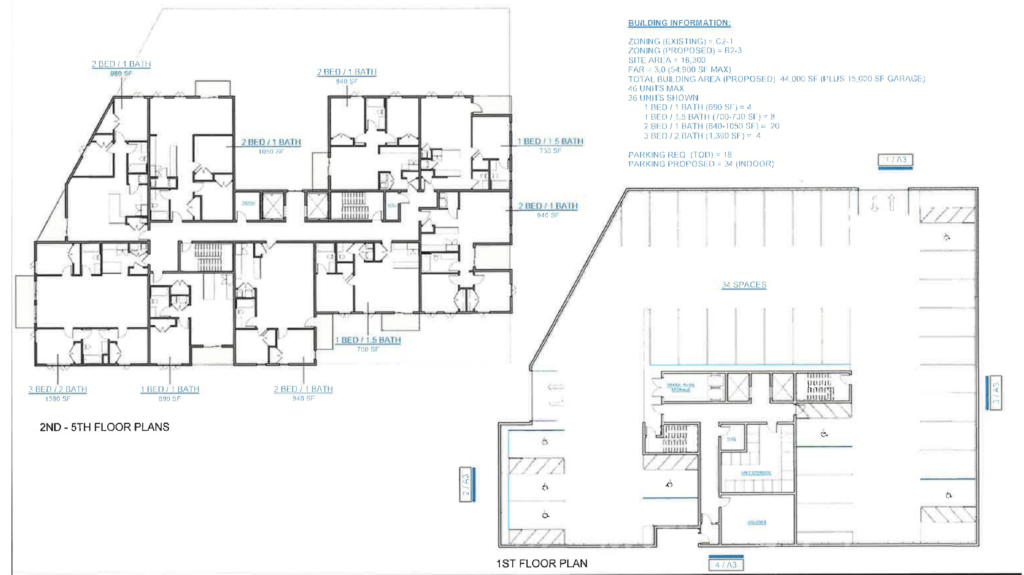
Floor plans of 1759 N Cicero Ave by Barry Architecture
Within this ground floor will be a small residential entrance, tenant storage space, and a 34-vehicle parking garage with entrances off both alleys to the north and west. The floors above will be set back from the side alley and will feature a total of 36 residential units. Of this total, eight will be considered affordable.
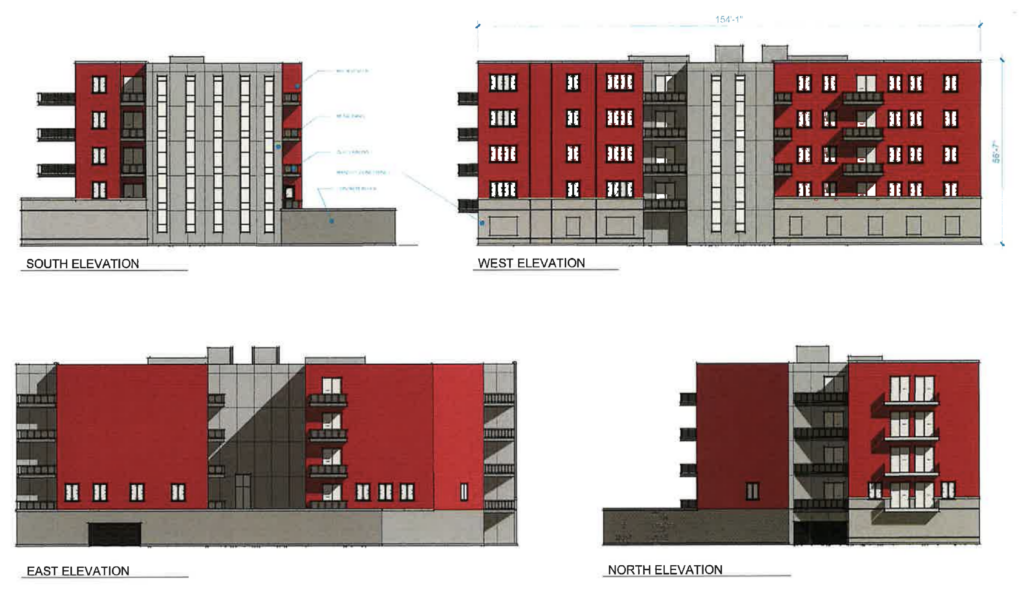
Elevations of 1759 N Cicero Ave by Barry Architecture
The units will be made up of 12 one-bedroom, 20 two-bedroom, and four three-bedroom layouts, ranging from around 700 to 1,390 square feet in size. The structure will feature cantilevered balconies and be clad in a unique red and gray panel exterior, with brick covering the lower level. The project has now submitted a zoning application in order to move forward.
Subscribe to YIMBY’s daily e-mail

Follow YIMBYgram for real-time photo updates
Like YIMBY on Facebook
Follow YIMBY’s Twitter for the latest in YIMBYnews
Oh gosh. Matt is right. They just don’t build anything outside Fulton Market. This project? Fake news.
But what’s the reason? What’s the question??
See example below. ↓
I love a good parody but I fear we may have some schizophrenia in the comments.
Mental health IS critical.
You can’t make half the sh*t in this thread up. 😂
An absolute cluster f of debauchery. I come back after a day on a beautiful mountain to see these word vomits. I really hope you respond so you can give the rundown of all this. (Cute name btw)
You can make it all up.
I didn’t make this up. “According to the Metropolitan Planning Council, between 2006 and 2024, just over 121,000 new homes were permitted (not built) across the city of Chicago. In a city of about 1.28 million housing units, that is fewer than 6,800 homes permitted per year. What’s most striking, though, is where these units were built. Sixty percent of the new homes were permitted in just five community areas of Chicago: the Near North Side, Near West Side, Loop, West Town and Near South Side. Furthermore, 45 of our 77 Chicago community areas received less than 500 new homes over the entire 18-year period.” Chicago Tribune, October 2, 2026.
“According to the Metropolitan Planning Council, between 2006 and 2024, just over 121,000 new homes were permitted (not built) across the city of Chicago. In a city of about 1.28 million housing units, that is fewer than 6,800 homes permitted per year. What’s most striking, though, is where these units were built. Sixty percent of the new homes were permitted in just five community areas of Chicago: the Near North Side, Near West Side, Loop, West Town and Near South Side. Furthermore, 45 of our 77 Chicago community areas received less than 500 new homes over the entire 18-year period.” Chicago Tribune, October 2, 2026.
Then we should criticize many of the systematic factors which make development more difficult in other areas of the city like how many banks are unwilling to give out financing for developments in much of the south and west side
Yes, we should. Banks are unwilling to lend because people won’t live in those areas. People won’t live in those areas because of the crime. The departure of those fleeing crime leads to declining property values. Declining property values reduce incentives to invest in property that will not hold its value. Property that will not hold its value leads to more departures and to declining neighborhood political power to fight against the crime that started it all.
Oh please! There are laws against red lining.
Banks back projects based on the financial viability of that particular project.
The reason no one is building there is because people with money don’t want to live there. Full stop.
Sale prices of homes will have to be cheaper and rents will will be lower the farther away you are from a desirable area in order to attract buyers/renters. This makes the financing less viable at the banks and REITs and increases the projects risks.
So to a risk adverse builder who has to partially back up their project with their own funds just to get their foot in the door of the entity with the real money, what are they going to do?
What makes a place ‘desirable?” ‘Desirability’ is not gravity. It’s not a force of nature. We create ‘desirability’ as societies.
You’re an idiot.
Thanks!
“Viability” is based on property values and property values are based on supply and demand. It all flows from property values, not some abstraction called “viability.”
Yep. Great to see common sense in the comments. It all comes down to crime. They like to point it’s 60 years low, just like it is nationwide, however Chicago still has 3-4 times more shootings and murders per capita than NYC, Miami, Austin. Cities we compete with. Vote accordingly.
Agreed, Chicago needs a progressive Democratic Mayor like Zohran Mamdani, Eileen Hughes, or Kirk Watson.
We also need a city council that is willing to double down on what has been working, rather than rolling back housing & safety improvements gained in the past few years.
Chicago “double downed” on affordable housing in the 1960s and 1970s with Cabrini Green Robert Taylor homes and such how did that bet go?
Remeber when they pulled the funding, stopped maintaining, and the structures were originally designed on an ocean of pavement with a couple crudy recreation structures?
We demolished the good chunks of Chicago, decimated their business districts, concentrated poverty with very little safety nets, and when things began to crack, it was a flood negative consequences.
If we are to criticize the Projects, you better start with the right “who”.
Affordable housing and public housing are different things. Publicly owned housing doesn’t help, and often hurts, property values, while privately owned affordable housing often helps property values. Making more affordable housing by reducing property values won’t work. We need more affordable housing that supports property values. That requires aggressive crime reductions, improved transit access, and the creation of functional property markets.
That is rough placement (industrial-lite area, not because of anything Matt says). Hopefully this serves as a catalyst.
Why did you decide to live where you live?
For the love of all, YIMBY, _please_ give these comment sections some basic post-1990s features. “Mute user” just for starters…functioning adults will not return after 2 or 3 visits to the adolescent clichepalooza that this place has become. There’s a reason that is now almost all that appears here.
Certainly an unexpected immediate vicinty for a residential project of this scale.
But I guess every place has to start somewhere.