
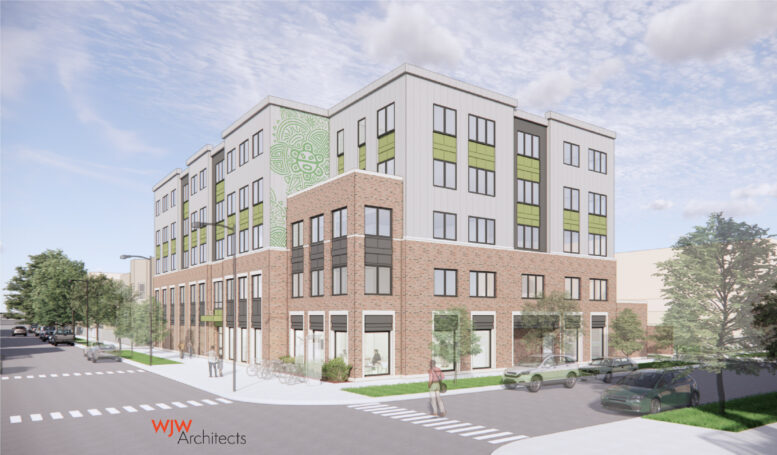
The Chicago City Council has approved zoning for the upcoming mixed-use affordable development at 3251 West Division Street in Humboldt Park. Revealed earlier this year at the intersection with North Spaulding Avenue, the project would replace a large vacant lot on the western end of the neighborhood.
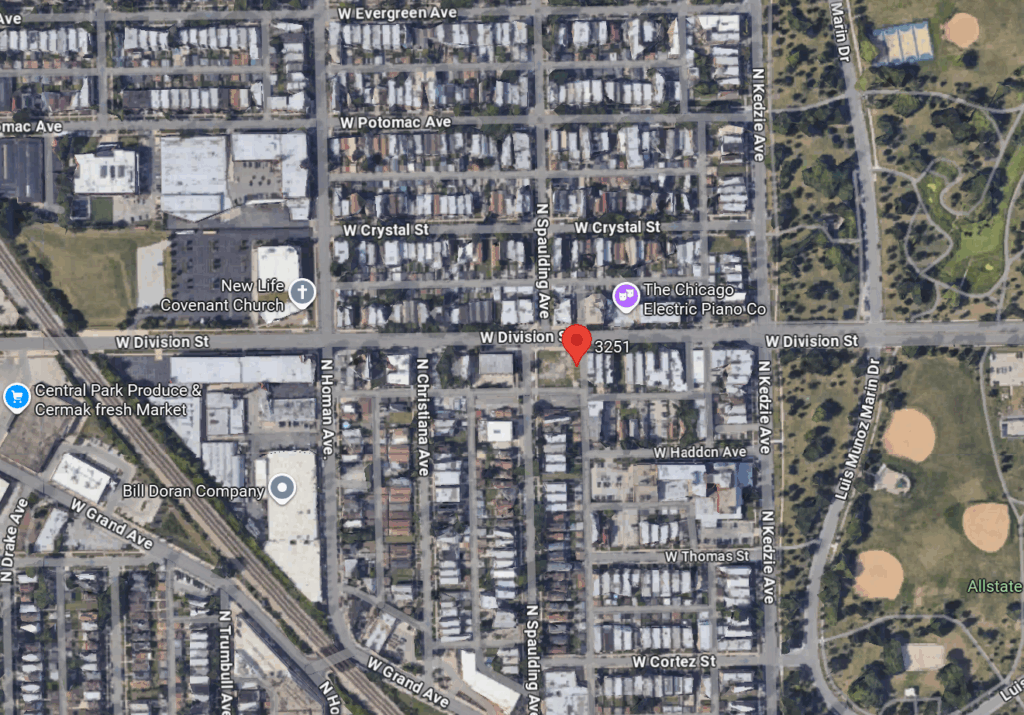
Site context map of 3251 W Division St via Google Maps
Chicago-based Hispanic Housing Development Corporation (HHDC) is behind the project, among other affordable developments in the area, and an earlier interview with their CEO can be found here. HHDC has been working with WJW Architects on the five-story proposal, which will be anchored by a 980-square-foot retail space and a 16-space parking garage.
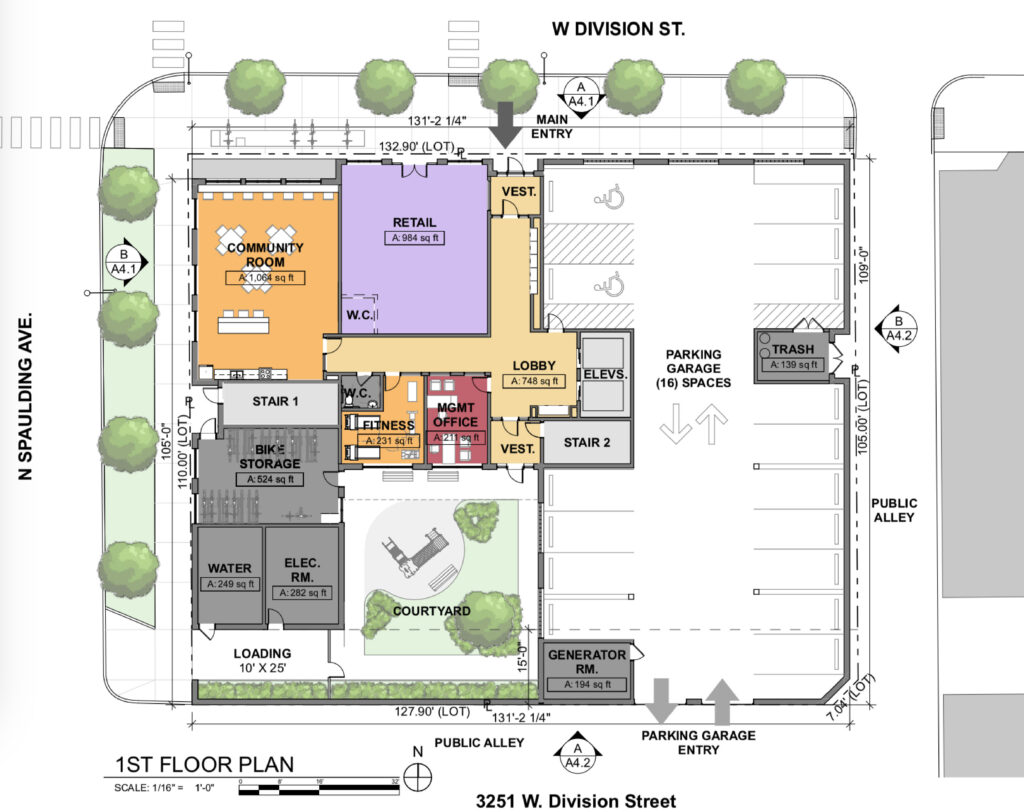
Ground plan of 3251 W Division St by WJW Architects
This will be joined by a community room, fitness room, and a small rear courtyard. The floors above will contain 44 residential units made up of 12 one-bedroom, 25 two-bedroom, and seven three-bedroom layouts. All of these will be considered affordable for those making 30 to 60 percent of the Area Median Income (AMI).
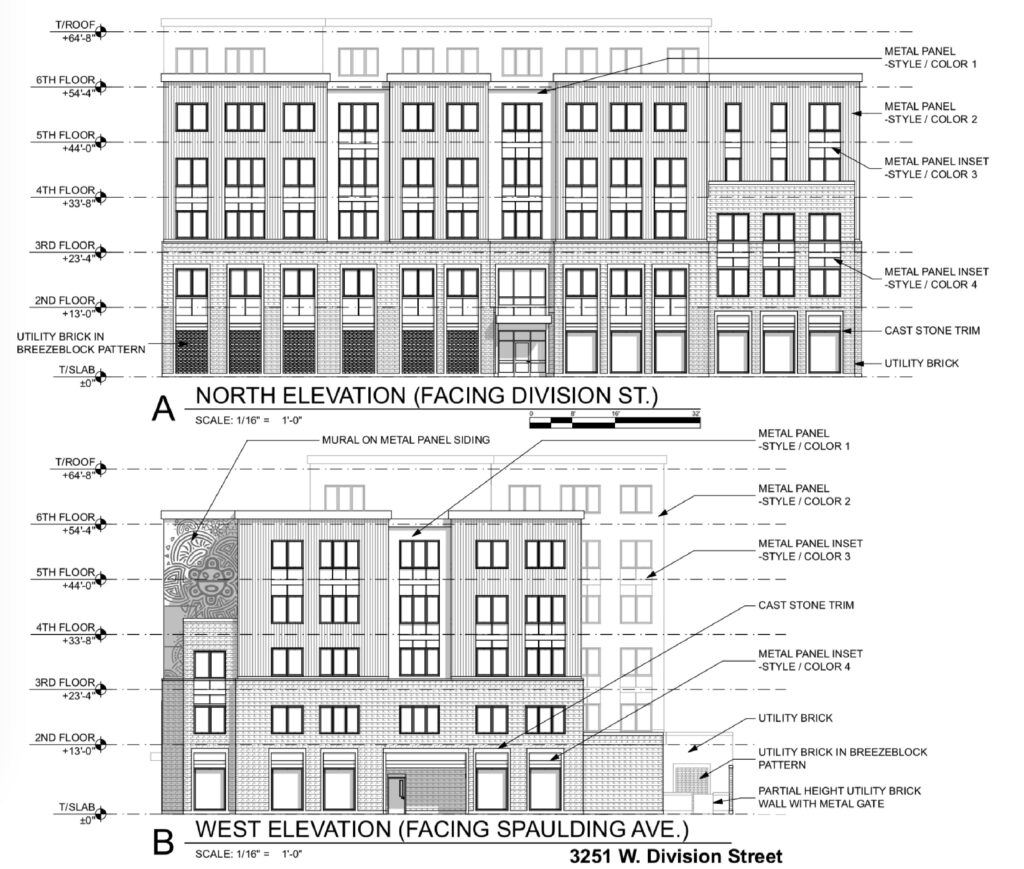
Elevations of 3251 W Division St by WJW Architects
The $36 million structure will be clad in light red brick at the base, accented by white and gray panels on the upper levels. The approval from the city brings the project closer to reality, now only needing city approval for around $10 million in financial assistance. If received, the team hopes to break ground next year and complete the project in late 2028.
Subscribe to YIMBY’s daily e-mail

Follow YIMBYgram for real-time photo updates
Like YIMBY on Facebook
Follow YIMBY’s Twitter for the latest in YIMBYnews
Those must be very high-end units at $818,000 per unit. It’s so odd that non-subsidized housing is costing about $300,000 per unit. One wonders where that extra $500,000 per unit is going. The Debt service can’t possibly be covered by rent. Is housing the new “Learing Center”?
“non-subsidized housing is costing about $300,000 per unit”, LOL! In 2010 maybe…in the real world, non-subsidized apartments in Chicago are averaging between $450K and $500K per unit.
“The Debt service can’t possibly be covered by rent.” Huh? My relative who’s a veteran commercial banker with many housing-construction loans on the resume asks, why not? What are you imagining _would_ be covering the debt service?
[To be clear I’m firmly in the camp that the way to get more affordable housing is simply to be building more housing; make me mayor and all designated “affordable housing” projects cease precisely because that is not the best way to achieve the policy objective. But hand-waving nonsense doesn’t advance that logic in the court of public opinion.]
Idk about that, the cost to build a market rate 2 unit building would be about 350k, and that’s per building.
Yeah it’s not 450 a unit unless you include land price in wicker park or Lincoln park (then it is high). Definitely post-land price of around 200-250 a unit as I’m in the business
“post-land price” can make a big difference in $ esp in areas either gentrifying or being speculated for future gentrification.
Do a land search in 60651 – the prices are pushing $100k for a typical Chicago lot.
I seem to have to repeat this every time, the total cost for these developments involve ongoing subsidies, management costs, & many expenses that are not recorded when a market rate development applies for a permit with their straight construction costs.
There is an incentive for elected officials to say “we’ve invested in affordable housing” whereas there is a disincentive for market rate developers to advertise their total spend, because they are trying to make profit beyond their carrying costs, so they don’t want to advertise them.
There is nothing affordable about “affordable housing”. It’s a scam and should be treated as such.
All housing is subsidized in the U.S. Free expressways, mortgage interest deductions, federal mortgage guarantees…..all housing is subsidized in the U.S. but McMansions in Naperville and Elgin are the most subsidized housing of all.
The choice isn’t between a ‘subsidized’ development on this land or a non-subsidized development on this land. The choice is between this development and no development at all on this land. This is meant to draw private investment to that area.
Sadly, the cost of these units ($818,000 avg) is typical of what it costs across the country, with much of that attributable to the additional requirements associated with receiving government subsidies. Changes at the federal level will be the major driving force in bringing costs down.
Can the federal government end free expressways, mortgage interest deductions, and federal mortgage guarantees?
I’d rather see affordable housing be developed this way than things like the CHA (I don’t believe the CHA should even exist). Let private developers, with the help of tax credits, build housing at full cost and the lease it at affordable rates.
All housing is subsidized in the U.S. If suburban McMansions are subsidized, urban middle-class apartments must be subsidized to get built.
That’s obviously not true. Plenty of private market rate development is happening in Chicago, and it’s happening at a cost way less than $36 million for 44 units.
Now stop spamming the same comment over and over in this thread.
The COO of the Hispanic Development Housing Corporation made $767,618 plus $49,453 in benefits for 2024 (from the most recently filed 990 for the non-profit HDHC). Additional salaries were $3.96 M. These two items accounted for roughly 44% of their activities. Their net asset value is $44.5 M. Their major source of income is “Program Services” at $12M which accounts for 78.5% of their total income. (Program services are undefined in the 990 form). They collected $525K in rental income for the year. (Even if this doubles with the new building, this won’t support any loan of a large size. In the private sector, building depend on their cash flow for solvency). They have outstanding liabilities of $31.9 M.
Once this building is completed, the public funding won’t stop. The difference between the market rent and the AMI affordable rent will continue to be paid by the variety of public programs. The true beneficiaries of this program appear to be 44 lucky tenants (who will of course be selected by a public lottery), the HDHC, and those who gained from the initial construction costs of $818K per unit.
Unfortunately, the taxpayers and the other unhoused persons or persons housed in unsafe conditions get nothing.
“The taxpayer” is a chicago resident.
Awesome project. This will be a nice upgrade for the neighborhood
Wheaton, Illinois is vastly more subsidized’ than anywhere in Chicago.
Market rate development in Chicago is happening where property values are greater than the amount of subsidization of suburban development. Suburban development is subsidized but it does not receive unlimited subsidies. Market rate development in Chicago happens where the increase in property values from new development are greater than the value of subsidizes of an equally priced suburban development. “Affordable” housing projects are funded the way they are to match the value of indirect subsidizes to suburban development. Without that, this land would not have had any value to any private developer.