

Further details and renderings have been revealed for the upcoming hospital tower at 333 East Huron Street in Streeterville. Set to replace one of the largest vacant lots downtown, the new tower will be an expansion of Northwestern Memorial Hospital and would add to the hospital’s cancer facilities as well as overall bed-count.
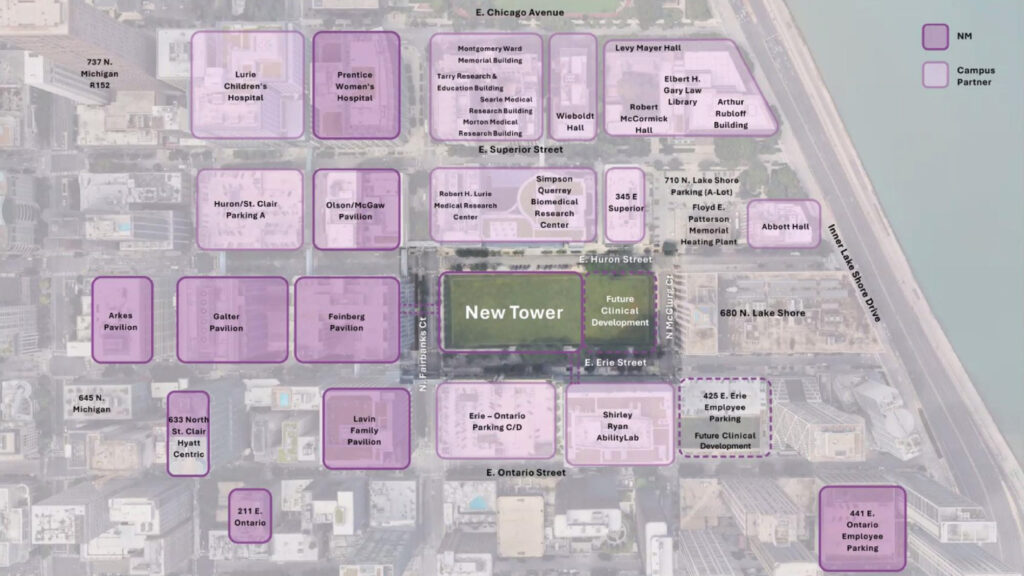
Site map of new Northwestern hospital tower by Perkins&Will
Details were initially revealed nearly a year ago, marking the potential end to the fenced-off, grass-covered lot which was the former home of the Lakeside Veterans Affairs Hospital, demolished by Northwestern in 2009. Northwestern Medicine has been working with architecture firm Perkins&Will on the 24-story structure that will sit on the western end of the site.

Rendering of Northwestern hospital tower by Perkins&Will
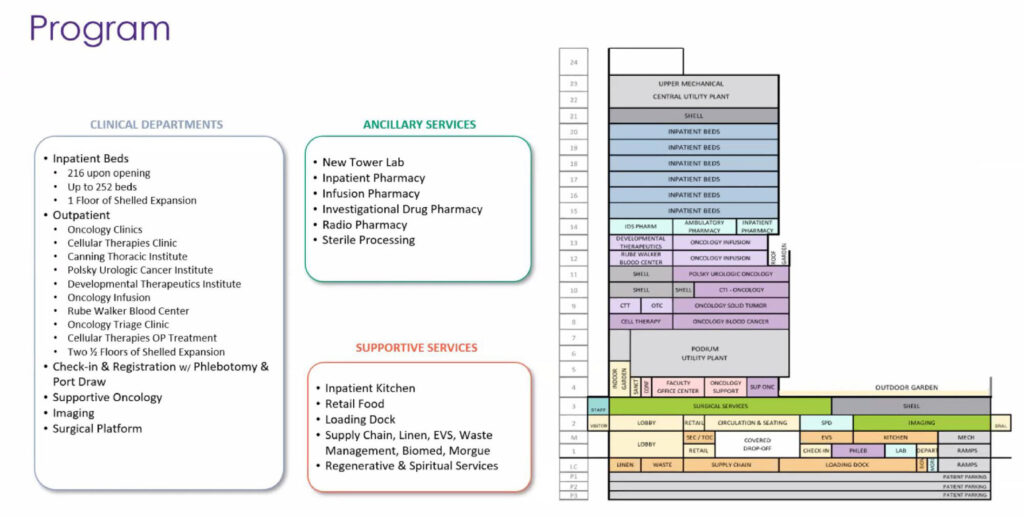
Section program of Northwestern hospital tower by Perkins&Will
The 427-foot-tall tower will re-utilize many of the remaining caissons from the demolished hospital, adding depth to some and a few new ones as well. This will support a four-story underground structure with three levels of parking and one level of support spaces, containing a total of 600 spaces for visitors and staff. This will be accessed from Huron.
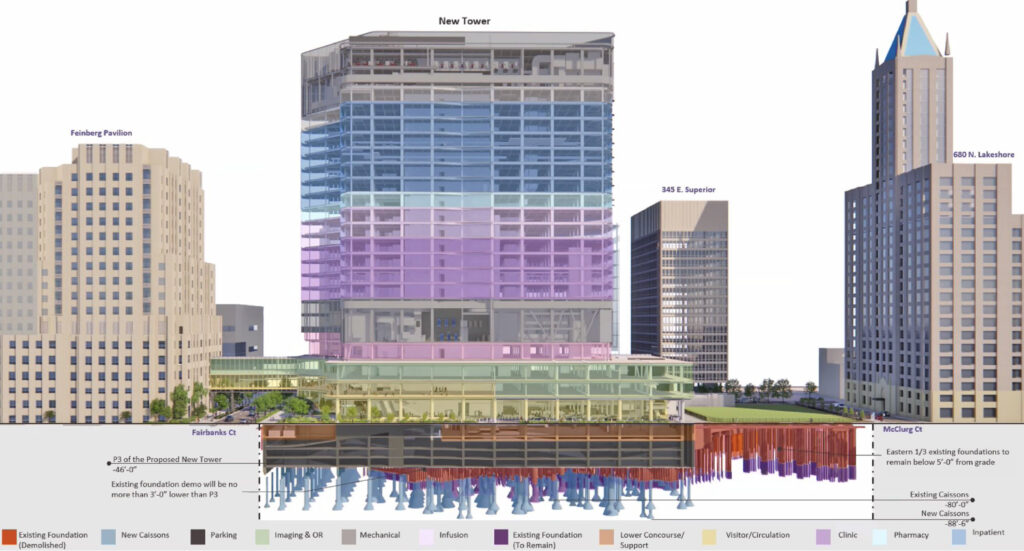
Northwestern hospital tower by Perkins&Will
The ground floor above will feature a pedestrian entry plaza on the corner of Fairbanks Court and Erie Street. This will connect to a vehicle drop-off loop along Erie, and a large retail space with an outdoor patio along Fairbanks. The rest of the floor will hold the phlebotomy department along with a massive elevator bank for the upper levels.
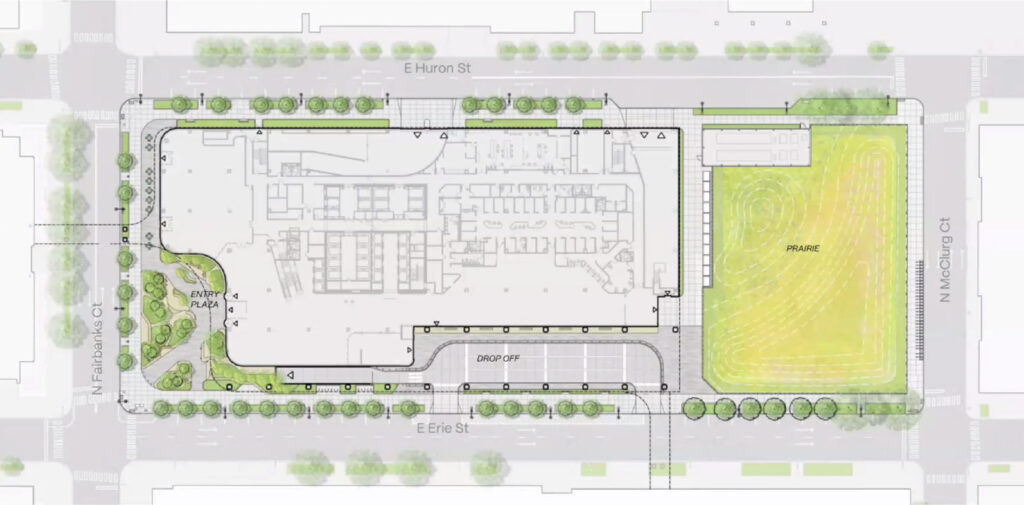
Site plan of Northwestern hospital tower by Perkins&Will

Rendering of Northwestern hospital tower by Perkins&Will
Within the rest of the four-story podium will be a large kitchen, imaging center, surgical services center, additional retail, excess space for future expansions, and pedestrian bridges to the Shirley Ryan AbilityLab and the Feinberg Pavilion, where patients will have direct access to its surgical facilities. The podium will be capped by a large rooftop garden and hospital offices.

Rendering of Northwestern hospital tower by Perkins&Will
The first portion of the tower through floor 14 will contain a three-story utility plant, multiple pharmacies, various clinics like oncology, cellular therapy, and oncology triage, as well as space for various other outpatient services like therapeutics, infusion, urology, and more. The next six floors will hold 216 beds, with a shell seventh level above to expand up to 252 beds.

Rendering of Northwestern hospital tower by Perkins&Will

Rendering of Northwestern hospital tower by Perkins&Will
Capping the structure will be another two-story utility plant and mechanical penthouse. The structure will be clad in a glass curtain wall with vertical metal fins, similar in style to the hospital’s other recent additions. The team will now pursue certification from the state prior to beginning site demolition work this fall.
The new building itself is expected to begin construction in spring 2027 and be completed in 2031, per a community presentation this week.
Subscribe to YIMBY’s daily e-mail

Follow YIMBYgram for real-time photo updates
Like YIMBY on Facebook
Follow YIMBY’s Twitter for the latest in YIMBYnews
Skybridges are an eye sore…
In the medical world, they are an important piece of infrastructure.
These bridges allow all these individual hospitals to be connected as one, creating a massive network of facilities. A child at Children’s Memorial can move to a different facility without risking exposure outside if immune compromised. Underground tunnels would be substantially more complicated to work around. Having a view of the outside also boosts mental health. Someone can see the seasons change, interact with the street, see Christmas lights, or watch a peaceful snowfall.
Compared to crumbling concrete brutalist ones from the 70’s, these are much more elegant. I’d take the practicality of these bridges for patient safety than risk a cancer patient catching a cold any day.
I agree, and they’re a big problem in a city like Minneapolis keeping their downtown dead feeling at the street level in many areas. But in this case, it does make sense in context and may even save lives not having to have patients cross the street in certain emergencies.
Boooooo, they tore down a masterpiece for this?!
What masterpiece?
If referring to Prentice Women’s Hospital, it’s been replaced for year on the site to the north. Wrong block.
And if talking about that hospital, it sadly was incapable of reuse without gutting almost everything within. The construction had too thick of concrete to get IT services to work. Simply drilling holes through the slabs was hell.
As a maternity ward, the rooms were depressing and having extreme imagining equipment next to expecting mothers is maybe not the best balance of a building. That was the last two uses before demolition.
If talking about the old Veterans Admin Research Hospital, I’m not sure I see the vision. Gang’s Rush hospital, gorgeous. Overall, I view hospitals as best to maximize the efficiency of lot and provide positive interiors that encourage healing. I know there’s some unique hospitals in the world, but most are far from dense urban environments and surrounded by an enclave of nature. Major cities don’t have that luxury. A little more green space for staff wouldn’t hurt, but medical equipment is a b*tch to fit into plan.
Old hospital buildings are extremely expensive to renovate. Standards for mechanical for modern hospitals are so high that they. just plain can’t be fit into old buildings without huge compromises. The biggest problem is HVAC – modern hospitals filter and move huge amounts of air which required loads of duct space and such. Just plain too difficult to fit into an existing structure.
And the old VA building also wasn’t very dense. The Nw’n complex is wedged into a very tight area, so they need to jam as much floor space as possible into what little land they have.
“Boooooo, they tore down a masterpiece for this?!”
You must be thinking of a different building. The Lakeside VA Medical Center was a generic brutalist hunk of beige.
This was where Lakeside VA hospital used to be. No big architectural loss there.
I’m simply pleased to witness expanded services for cancer victims. The large rooftop garden inn of itself can add to the research and public benefit component as we explore forest or nature bathing as therapy. The phlebotomy department can be a vocational entryway for CPS Duel credit programming. It’s important we keep thinking through built environments matching up with Unbuilt via natural spaces. Thanks Northwestern University!
I guess the best thing is that there is no hideous parking deck. I’m glad they made an underground lot rather that the latter.
Yeah, I’m still surprised that any new parking is being added even underground. This building literally has a skybridge to a massive parking garage that I’ve never really seen become completely parked up.
Does the zoning code require parking in this case even if they didn’t want to add it?
During a recent visit for a family member’s medical appointment, the large Huron/Superior garage was completely full and I ended up just circling around.
For Northwestern, design wise this is the best you’re gonna get. Prior buildings were just beige concrete, rinse and repeat. Here you have steel and glass, underground parking. I’ll take the win
I worked on this campus for 2.5 years. I have no idea where 600 more cars are going to flow. Yes, I understand that people need to drive to a hospital. But the gridlock is already insane.
Northwestern is a great part of Chicago but they also are looking to maximize their footprint and density here and it’s too much. This site must offer more in the way of public access green space than is proposed. Theirs is a healing mission and everyone including Northwestern Hospital employees, visitors and community residents need more than just attractive massive buildings
Theirs is a healing mission, and they need beds. Lots of them. They need clinics and pharmacies and physical therapy facilities and kitchens and surgical centers and so much more. And to do all that, they need a really big building. They aren’t just building this thing for fun.
There is no single place in Chicago better suited for a 24 story hospital than right here on this lot.
Lots of glass surrounded by planned trees and landscaping. I hope they plan on including bird safe glass on the lower 80 feet of the facade.