

Partial funding has been initially approved by the Community Development Commission for the first phase of Morgan Park Commons. Located at 11400 South Halsted Street in Morgan Park, the multi-phase development will replace a large vacant lot that formerly held a Jewel Osco shopping plaza on the corner with West 115th Street.
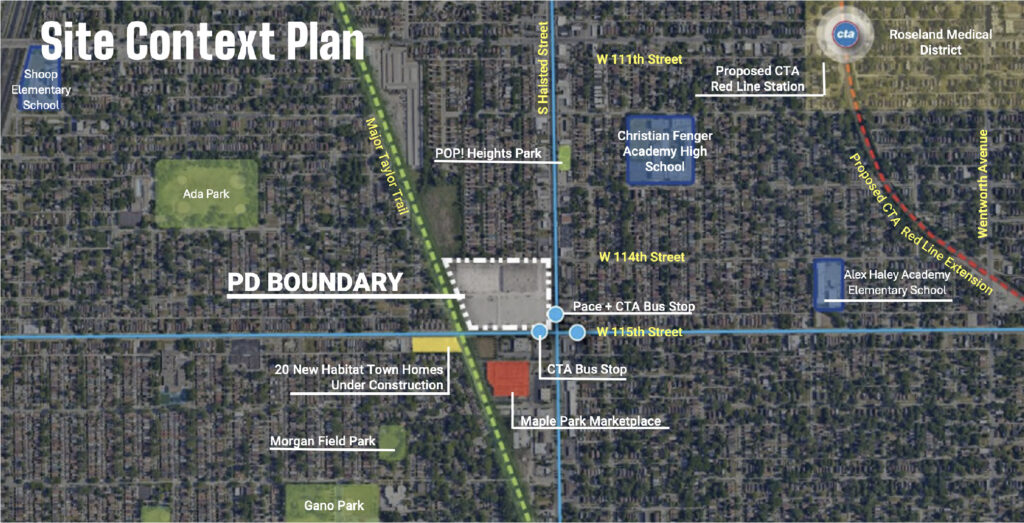
Site context map of Morgan Park Commons by LJC
The project has been in the works for a few years now, having been fully approved by the city late last year. Efforts are being led by the Far South Community Development Corporation, Preservation of Affordable Housing, and DL3 Realty, along with architecture firm Lamar Johnson Collaborative working on the design and master plan.
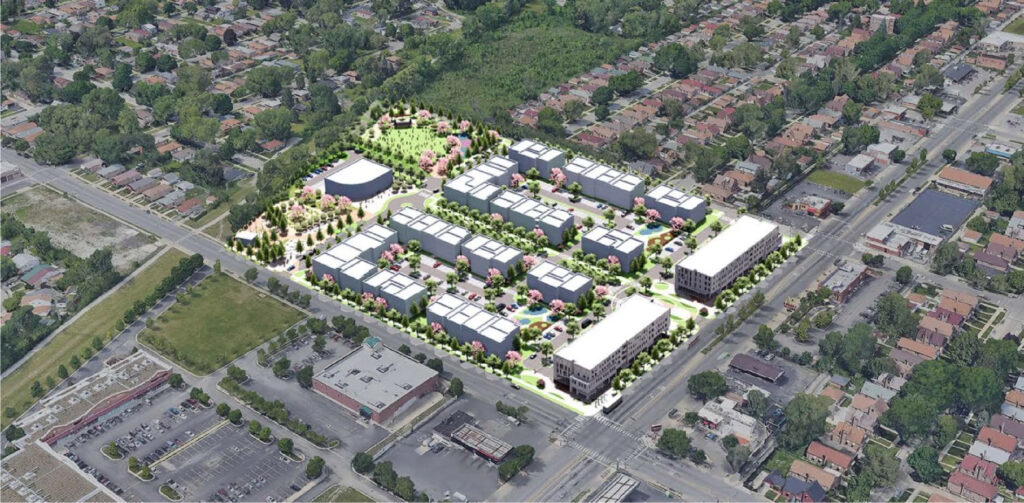
Updated site plan of Morgan Park Commons by LJC
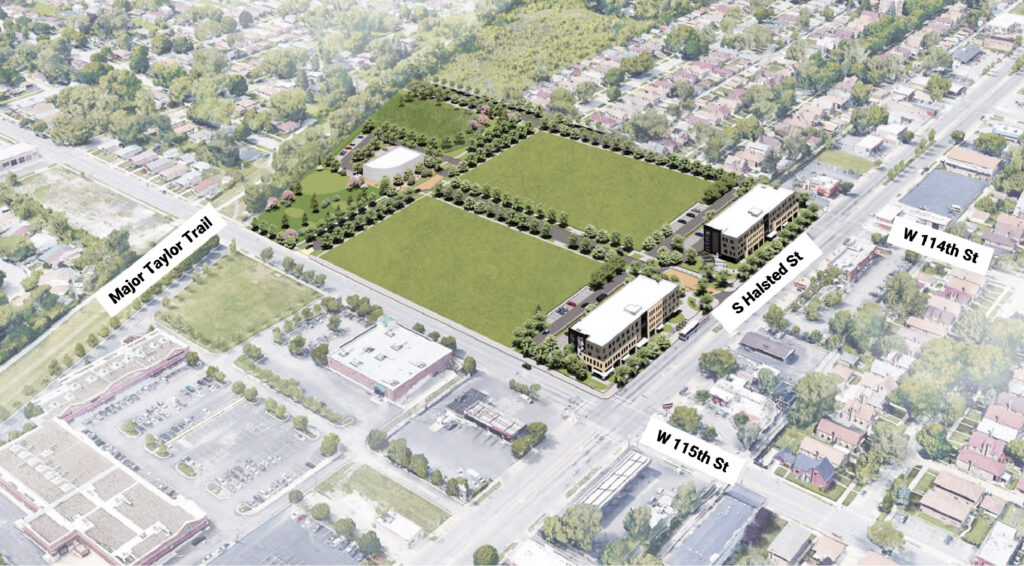
Site rendering of Morgan Park Commons phase one by LJC
Said first phase will feature two four-story buildings intersected by a new extension of West 114th Place. Both structures will feature two ground-level live/work units. The northern building will hold 1,200 square feet of retail space and a fitness room, with the southern building containing a community room and office space.
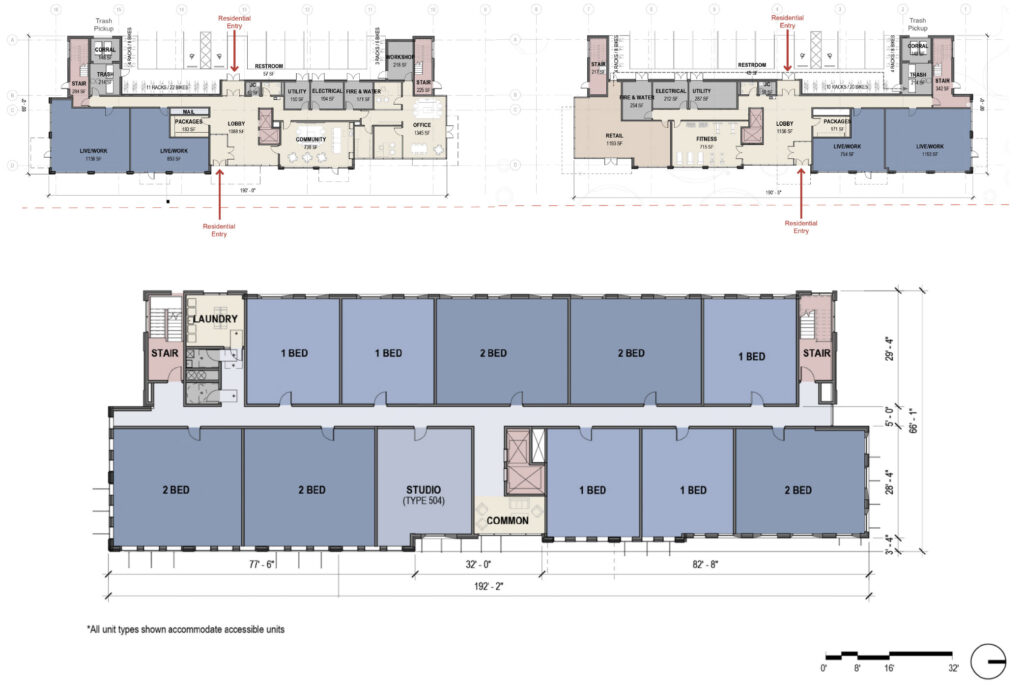
South (left) – North (right) ground floor plans and upper level floor plan of Morgan Park Commons phase one by LJC
Each building will contain a total of 35 units, including the two live/work units as well as three studios, 15 one-bedroom, and 15 two-bedroom layouts. Between the two, the project will deliver 70 units in total, of which 66 will be considered affordable. The structures will also share an 81-space parking lot in the rear.

Rendering of Morgan Park Commons phase one by LJC

Rendering of Morgan Park Commons phase I by LJC
The $54.6 million first phase is requesting $5 million in TIF money, which will now need to clear one more hurdle with the City Council. The developers plan to break ground on this phase later this fall. Future phases would bring a new park, a community center, and an additional 174 residential units across various buildings.
Subscribe to YIMBY’s daily e-mail

Follow YIMBYgram for real-time photo updates
Like YIMBY on Facebook
Follow YIMBY’s Twitter for the latest in YIMBYnews
Seeing the map with the Red Line hatched in shows how badly IL needs to do that wide sweep of by-right localized up-zoning. Pair with single-stair reform, this area is severely too sparse for such a transit system to be implemented. Bypass the restrictive density so the Red Line can make more sense (from a financial perspective).
Chicago could benefit from CA’s SB79, with major density boosts 1/2 mile from transit stops. Single-family homes are not going to cut it.
Not sure what you are saying….but sounds good
Not enough homes exist near the Red Line expansion. This area is not zoned for dense housing in its current state. (Low-rise and single-family.)
To speed up the process of correcting and enabling new investment in the region, the new housing laws introduced by the Khan of IL need to be passed. Pritzker’s new build agenda is very mild but could help in big ways in areas like this. It would also help the rhetoric of “should we expand the Red Line?” Right now, we’re stuck in the headspace of “do they deserve the expansion?”
The debate over the Red Line isn’t “are the residents of Roseland deserving?” It’s “OMG, how can they spend a billion dollars a mile on a surface level train?”
For reference, Barcelona just built 27 miles of subway (which means building a tunnel, folks!) with 52 stations for about $7.5B. The Red Line Extension is going to cost $5.5B for 5 miles of surface track with 4 stations.
Something is badly out of whack on this project.
And the President is building a ballroom from “donations” at the cost of $400 million, but estimates are saying $1 billion, and a US senator is graciously offering our money to foot the entire bill.
We are not a serious country, and the systemic issues expand far beyond Chicago’s reach.
The Feds are covering a massive chunk of it, and I am much happier to waste money on infrastructure than on a $1.5 trillion military budget. At least construction folk spend their embezzlements locally.
27 miles for 7.5 billion is a deal why can’t chicago make that deal 52 stations what the hell
Because the average wage in Barcelona is around $40k USD. That’s only $10k more than minimum wage in Chicago.
Cost of living is significantly less and Spain enjoys that basic privilege of healthcare provided by country instead of a ball and chain dependent on your production value.
Our country would need earth shattering switch ups of daily life to afford that cost-per-mile. For staters, universal healthcare would be one of the biggest ways to make infrastructure cheaper.
If you don’t mind can you explain how universal healthcare would impact infrastructure cost. Is it simply that employers wouldn’t have to spend money subsidizing private insurance premiums?
Look at the costs of union benefits. The health insurance aspect is probably one of the most enticing things for your family to be employed by one, beyond the extra protections of employment and safety.
The use of union labor is one of the biggest reasons public infrastructure is so expensive. It’s a premium to use labor that properly affords its employers a living wage. One of the most expensive components of union fees is to support the insurance pool, which when someone, like my dad, gets injured, he’s not risking the entire family’s safety by his back injury. Notch off that component of union labor, the service becomes significantly cheaper. This doesn’t solve all issues piling on costs, but it’s a big one.
Look at part-time workers in the service industry. There’s a reason no one schedules college kids and adults to get that full-time status. I was consistently scheduled 39.5 hrs/wk. In CA, that drops to a base need of 30 hrs/wk and the companies do the same thing. It’s not like they want to screw us, they simply can’t afford to add them on with thousands of extra dollars in expenses with already thin margins.
Why are hospitals so expensive? Because the insurance is what eats us alive. You’re not paying for the service, you’re paying for the doctors and nurses to remain legally capable.
Take away health insurance being tied to labor and you’ve just broken our entire economic system of exploitation. It’s why my job advertises I am making $97k a year in benefits when the pay is more like $74k. My high-deductible of almost $6k just to use the services I am awarded eats into that even deeper. We keep on pushing the burden of those costs onto the lower guy and it’s why it seems we can’t build anything cool anymore. Finishes and details are eaten up by everything else. The final product is all we care about. We are currently operating against a system of abundance… which isn’t inherently a bad thing. It makes us more efficient. But the cost of efficiency has also been a loss is opulence, something we love to celebrate, but only the most well-off can afford.
Specifically the Red Line… there is definitely more fishiness at play. Would love to see that paper trail.