
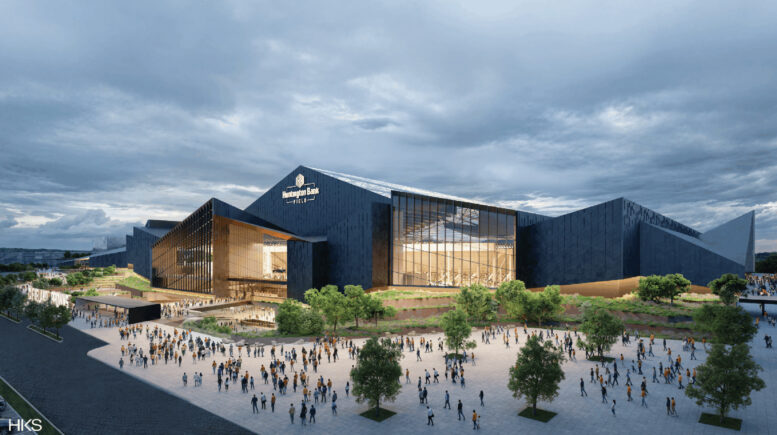
Chicago YIMBY’s Sister Cities series is back for its second iteration this year. This time around, we are taking a look at two massive redevelopments in nearby Cleveland, Ohio. The first is the new Cleveland Browns’ Huntington Bank Field and surrounding mixed-use campus, followed by the city’s new masterplan to replace its former lakefront stadium.
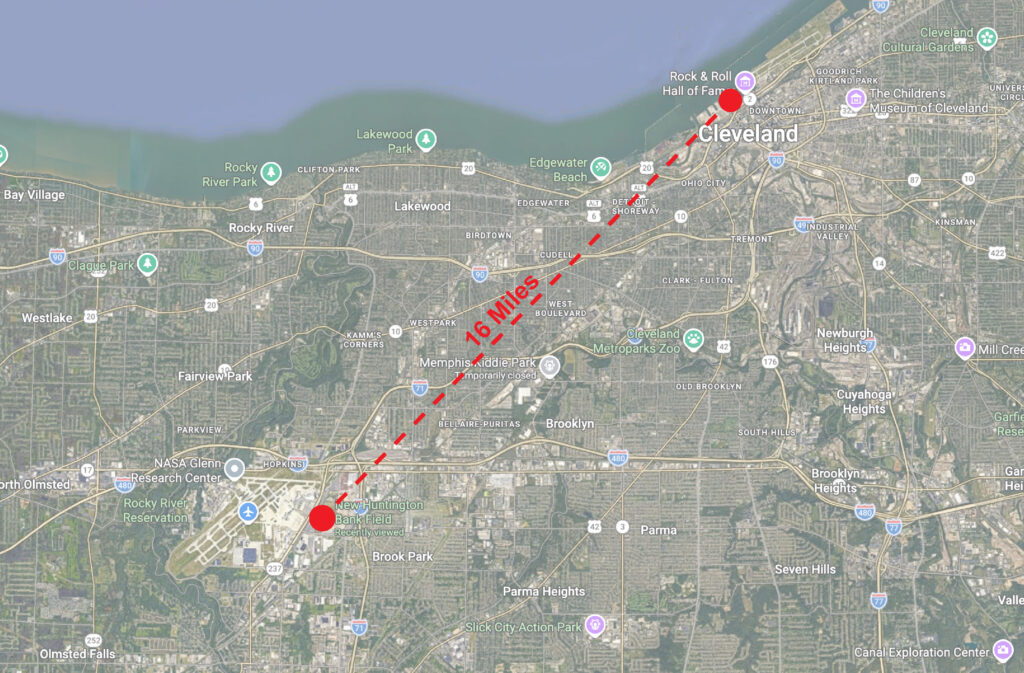
Distance between two stadiums via Google Maps
In a story too familiar to Chicago, the City of Cleveland has been working through its football team relocating from its current open-air lakefront stadium, built in 1999, to a new domed facility with an attached entertainment district in the nearby suburb of Brook Park. This is leaving behind a roughly 50-acre site for redevelopment.
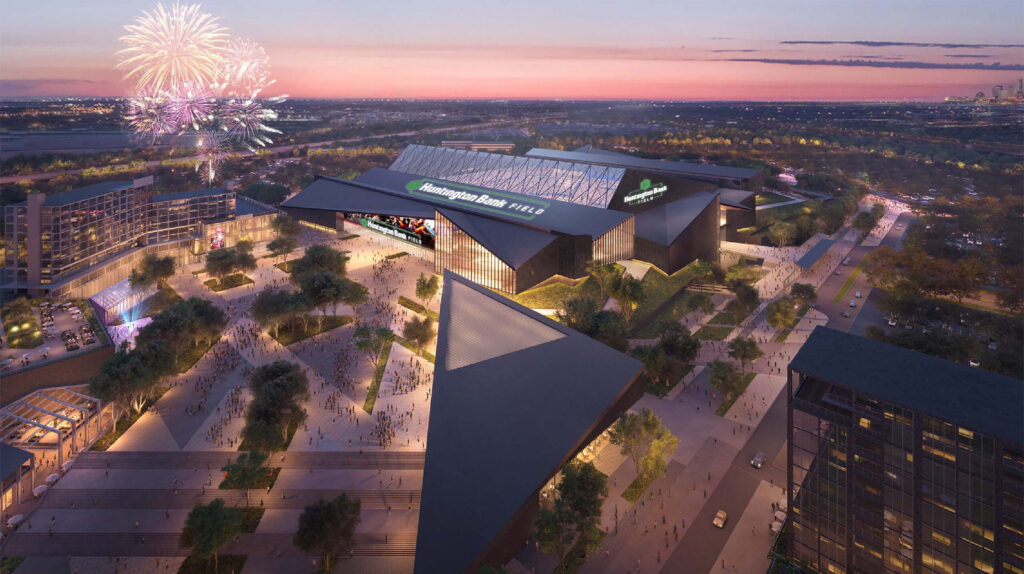
Rendering of new Huntington Bank Field by HKS
The Road To A Suburban Stadium
Though in development for years before, in 2024, the team’s owning family announced its plans to build a large new stadium complex at 18300 Snow Road, directly across the street from Cleveland Hopkins International Airport. The project is replacing 176 acres of vacant land previously used for industrial purposes with a new district known as Brownstown.
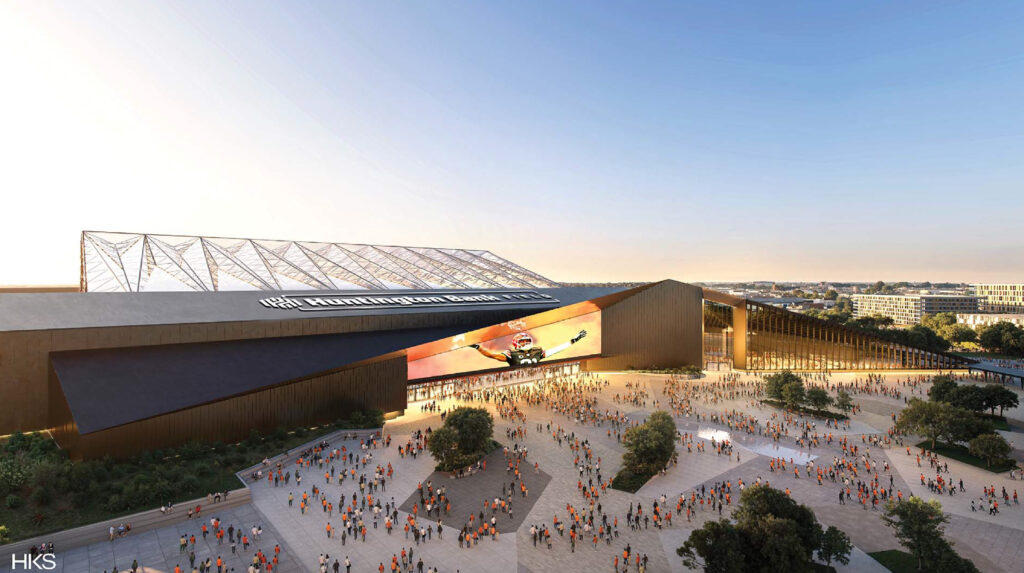
Rendering of new Huntington Bank Field by HKS
The $2.6 billion development did not come without hurdles. Once announced, the project was hit with a lawsuit from the City of Cleveland due to its violation of Ohio’s Modell Law. This prevents sports franchises from leaving publicly funded facilities, a similar story to Soldier Field. The city council also voted down $1.1 million in repairs to the current stadium.
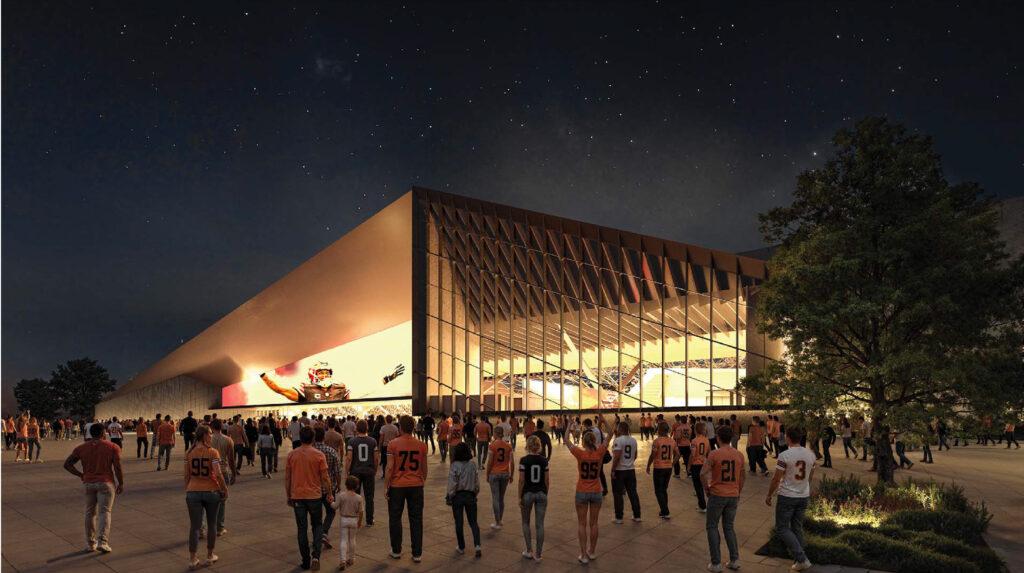
Rendering of new Huntington Bank Field by HKS
Among other opposition, the plan remained in litigation for almost a year before a $100 million settlement was reached in late 2025. This included a $25 million upfront payment, $30 million to fully demolish the existing stadium and surroundings to prepare for new development, five years of $5 million annual payments, and $20 million for community benefit projects.
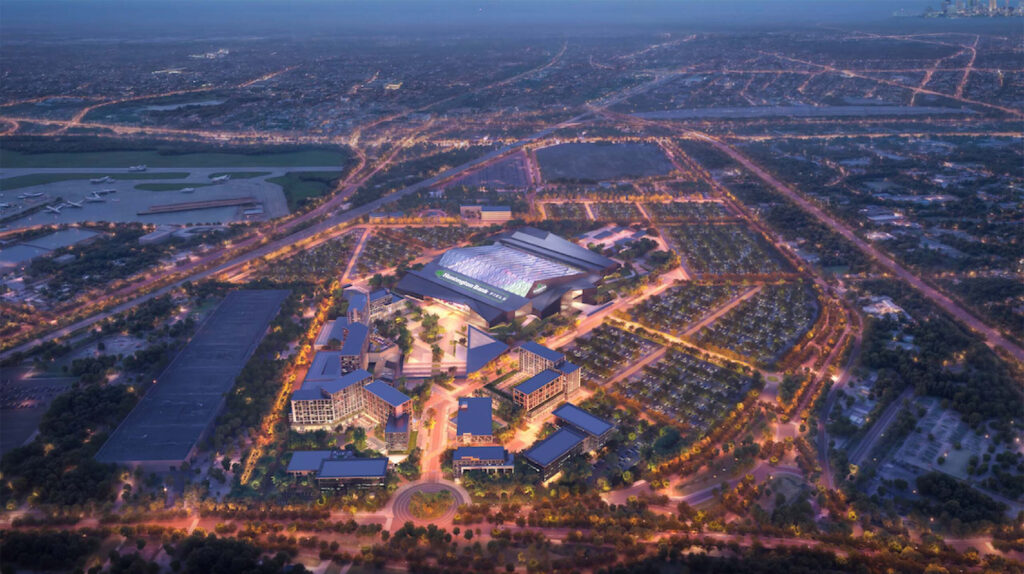
Rendering of new Huntington Bank Field by HKS
To fund the stadium, the team received $125 million in public funds for infrastructure at the site, $600 million from the state in the form of a grant to be repaid through generated revenue, and $245 million from Brook Park. The remaining $1.75 billion, or two-thirds, comes from the team. The Browns are worth around $6.4 billion, per Forbes. In comparison, the Bears are worth $9.7 billion.
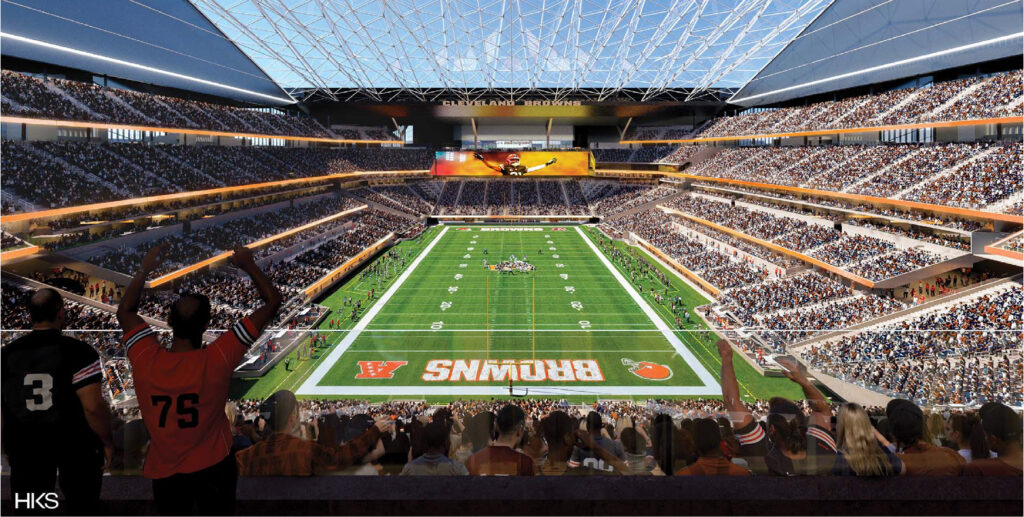
Rendering of new Huntington Bank Field by HKS
New Huntington Bank Field + Brownstown
Once the above was settled, the team was able to break ground on Brownstown in early 2026. Due to its proximity to the airport, the stadium itself sits 80 feet below ground and is being designed by architecture firm HKS. Its design takes a more unique approach than many of the recently revealed stadiums.
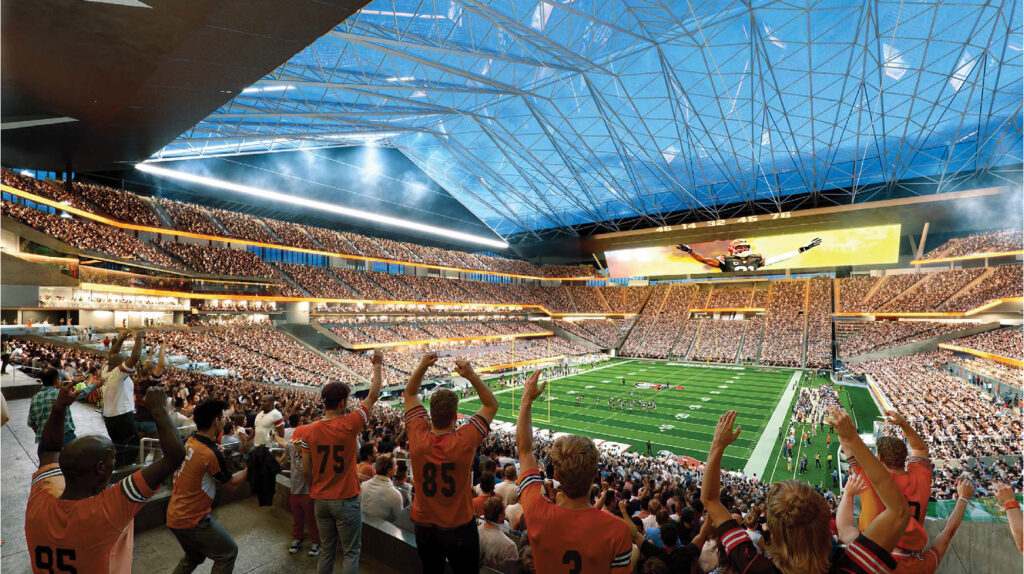
Rendering of new Huntington Bank Field by HKS
The stadium itself will have a capacity of 67,500, plus 2,500 standing-room spaces, bringing it to the exact NFL minimum of 70,000 to host a Super Bowl. Soldier Field’s capacity is roughly 61,500. The roof, fan seating section, and massive video screens are all designed to amplify the crowd noise while providing some of the closest views of the field of any stadium.

Rendering of new Huntington Bank Field by HKS
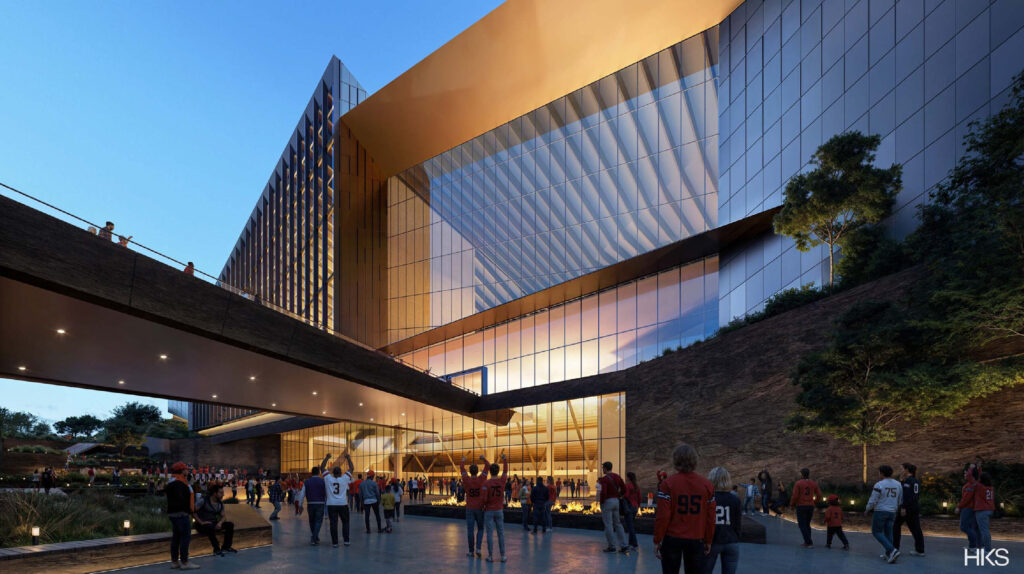
Rendering of new Huntington Bank Field by HKS
The aforementioned roof is inspired by the city’s iconic arcade buildings and will be the first long-span roof without a massive central truss. The exterior will mimic the waves of Lake Erie through its materials and plazas as well. Surrounding the stadium will be over 10,000 parking spaces across surface lots and parking garages.
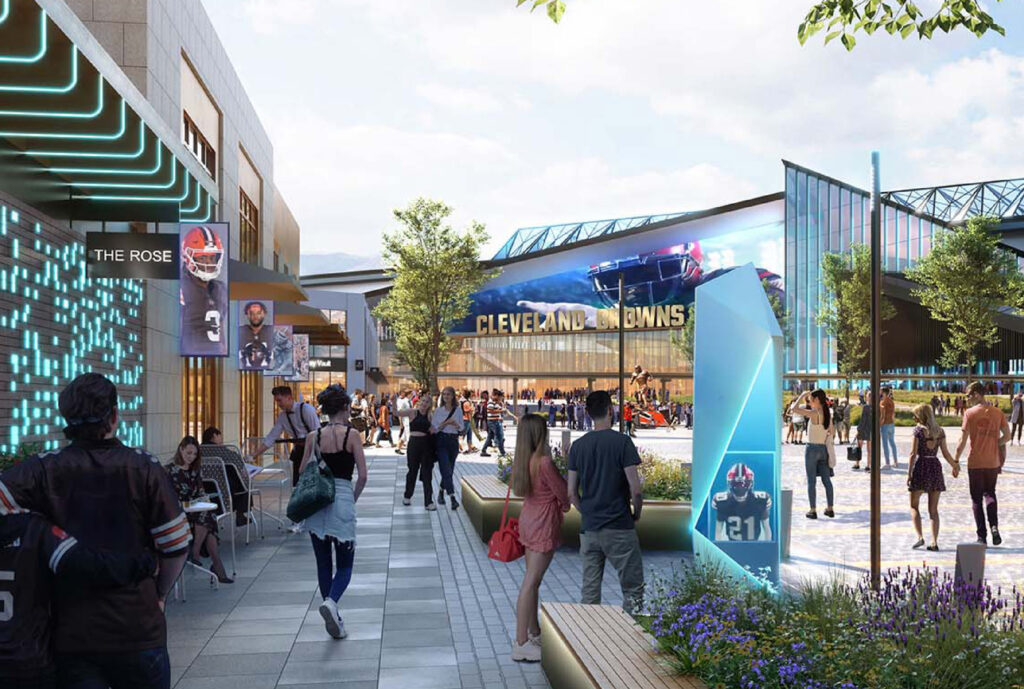
Rendering of new Huntington Bank Field by HKS
Directly adjacent to the stadium will also be the aforementioned mixed-use district. The $1 billion project is being separately funded and built by Texas-based developer Lincoln, who is also behind the stadium. This will feature 300,000 square feet of retail space, 500,000 square feet of office space, two hotels with 450 rooms combined, and 1,100 residential units.
The stadium is set to be completed and open for the 2029 NFL season.
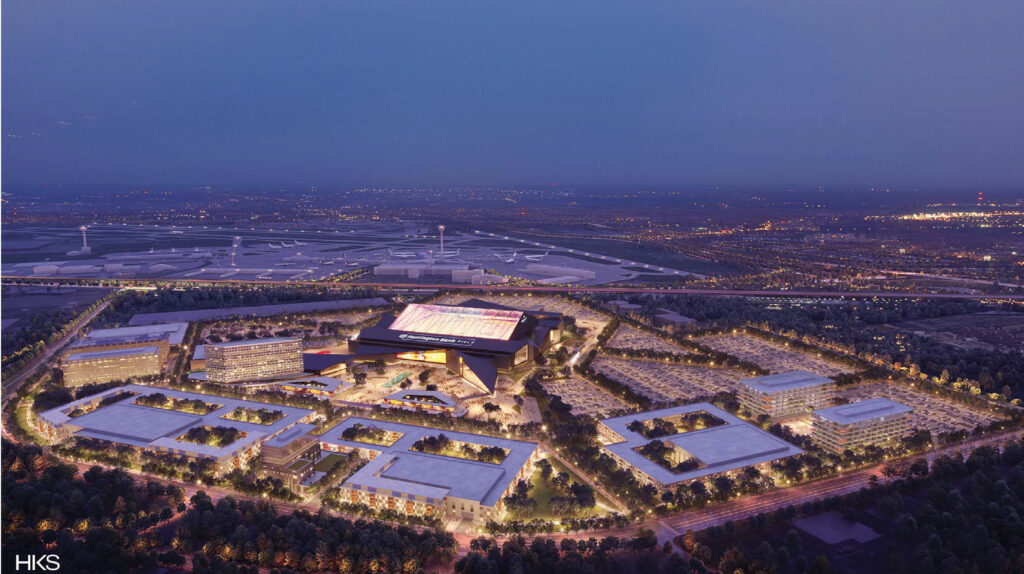
Rendering of new Huntington Bank Field by HKS
Downtown Lakefront Redevelopment
Since clearing their legal agreements, the city has been working on a vision/masterplan for the existing site. The site is currently a concrete peninsula, meaning any development would need to work on attracting visitors removed from existing density. To do this, the city envisions a mixed-use neighborhood with parks and improved lake access.
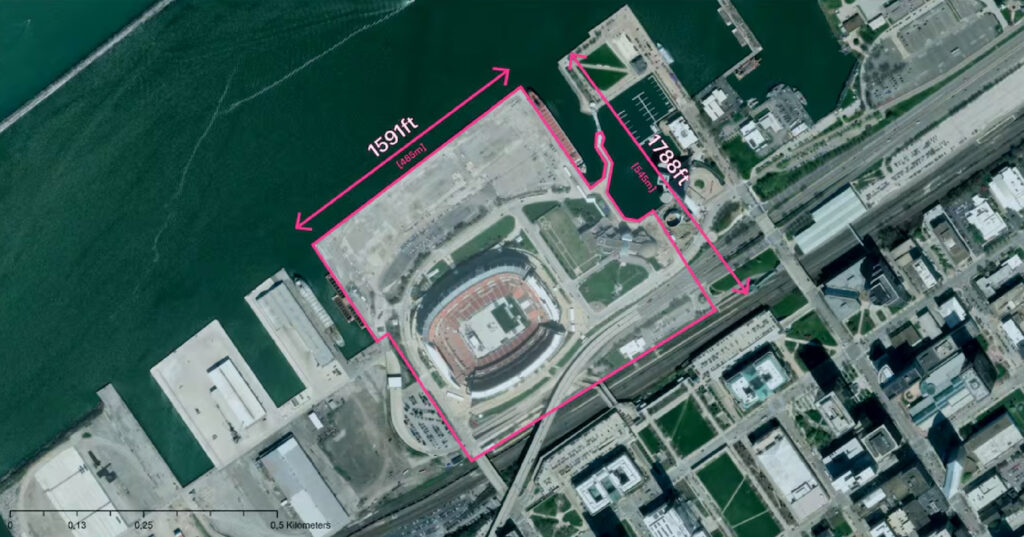
Plans for lakefront redevelopment via North Coast Waterfront Development Corp
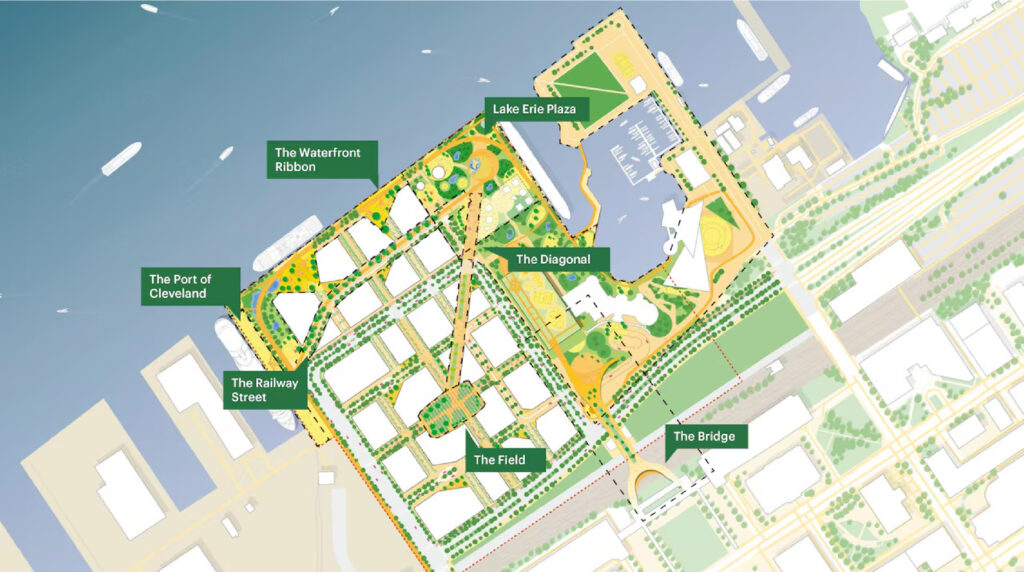
Plans for lakefront redevelopment via North Coast Waterfront Development Corp
As mentioned, the plan will allow the city to work on designing and building infrastructure that will allow private developers to build out the area. At the heart of this will be a new football field-sized park located where the former field was. Surrounding this will be four different mixed-use ‘districts’ with a new street grid traversed by a diagonal road.
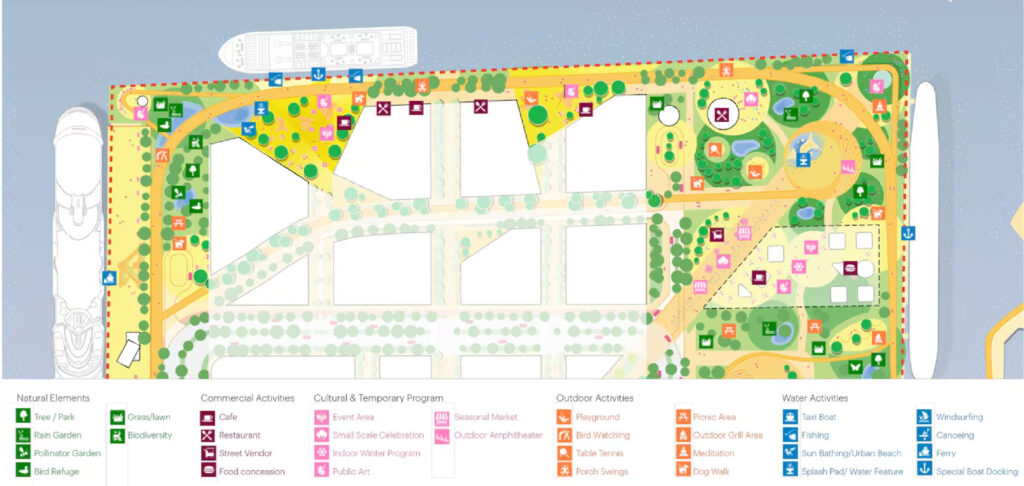
Plans for lakefront redevelopment via North Coast Waterfront Development Corp
This begins with a waterfront park ribbon along all three sides, culminating at a large new park and plaza on the eastern edge that incorporates Steamship William, the Great Lakes Science Center, and the Rock & Roll Hall of Fame. This would be the waterfront park district and would feature play elements, a small amphitheater, a restaurant, a market hall, and more.
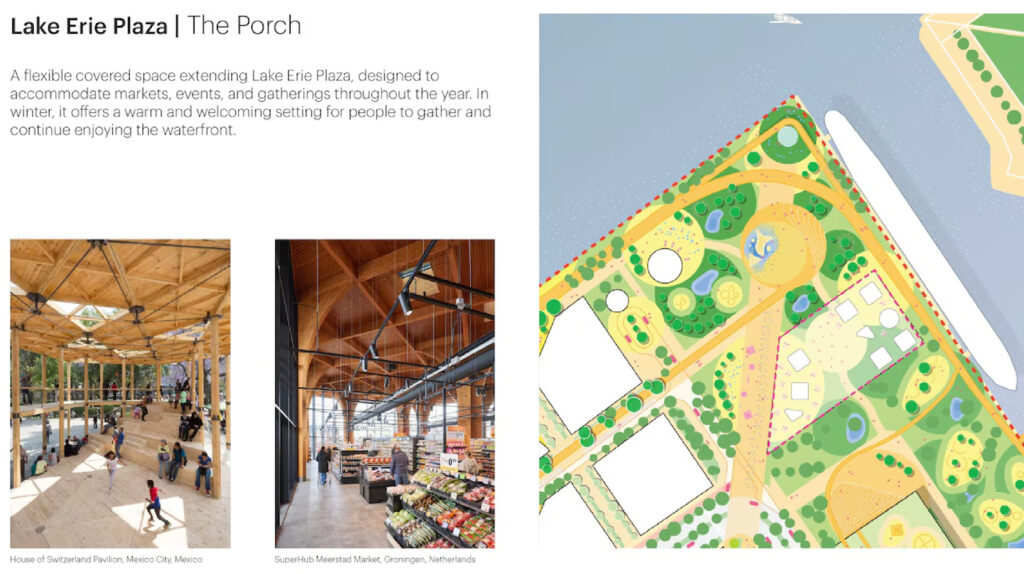
Plans for lakefront redevelopment via North Coast Waterfront Development Corp
To the west along the water will be the lakefront district. This small mixed-use area will incorporate additional waterfront plazas, nature areas, retail, and a new structure for the Port of Cleveland. This would allow the city to host increasingly popular Great Lakes cruises, ferries, and water taxis. Fishing docks and an urban beach are also planned.
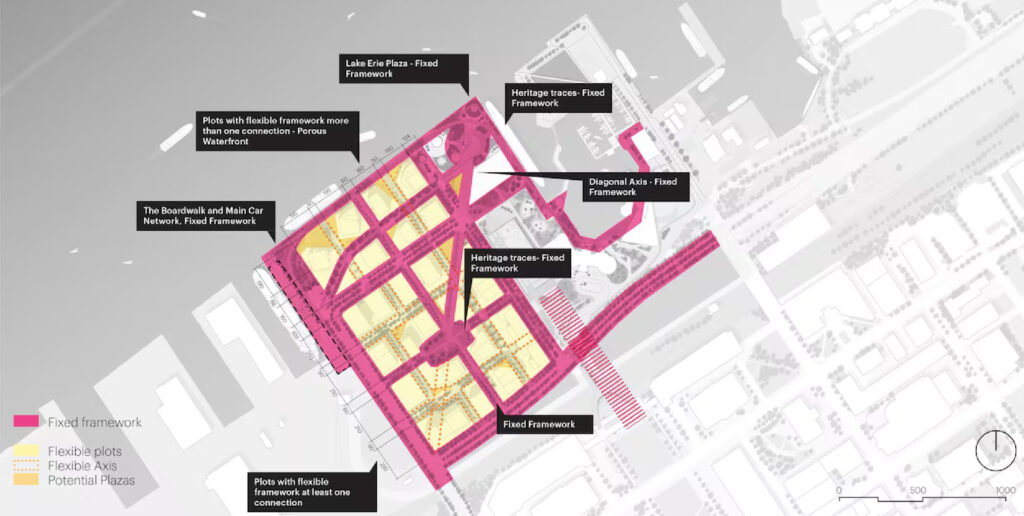
Plans for lakefront redevelopment via North Coast Waterfront Development Corp
South of here will be the last two districts surrounding Field Park. The community hub would focus more on cultural sites and community spaces, while the neighboring innovation quarter would focus on potential office and lab spaces for companies. The city has collected around $150 million to cover infrastructure work to partially begin ahead of the stadium’s 2029 demolition.
– –
Thanks to all for reading our Sister Cities series, we are always looking for more regional projects to cover. Please let us know any additional request!
Subscribe to YIMBY’s daily e-mail

Follow YIMBYgram for real-time photo updates
Like YIMBY on Facebook
Follow YIMBY’s Twitter for the latest in YIMBYnews
Be the first to comment on "Sister Cities: Cleveland’s New Football Stadium Leaves Empty Lakefront Site"